The device in 360°, and what makes real treatment / crew / UGC footage read real
Your v8 note: the handheld study isn't accurate yet, still pale, angles staged, 0:02 fake UGC, 0:03 fake skin tone. Below: UKIYO's own 18 raw clips studied for the device, your three reels decoded shot by shot, the colour measured, and the fix, mapped with Jev. Nothing new is generated until you approve the proof.
Approve the proof (about 15–20 credits)
One treatment shot made from UKIYO's real clip IMG_8144 (real device, real motion; Mei's face, outfit and the UKIYO room) and one real-UGC selfie (her bathroom, window light, real skin), before any full reel. The test has used 120.75 of the 125 credits I set for it. Approve, or tell me what to change.
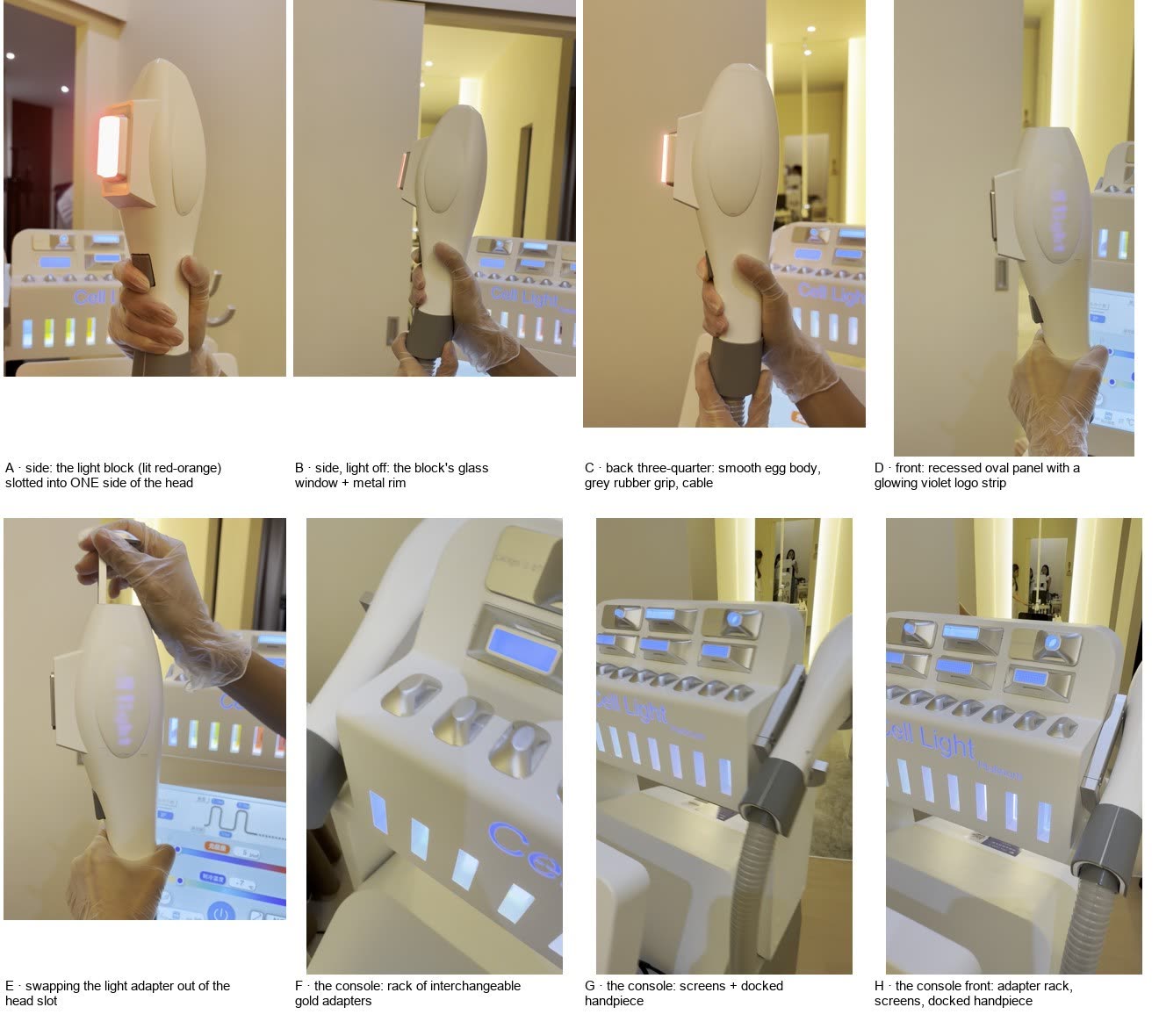
1 · The device, every side (from UKIYO's own clips, device-only frames)
2 · Your two notes, side by side with the real thing
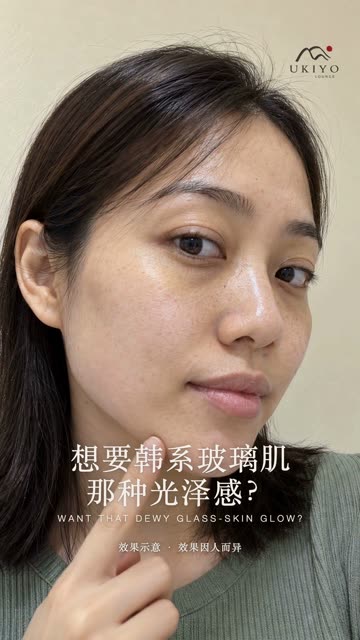
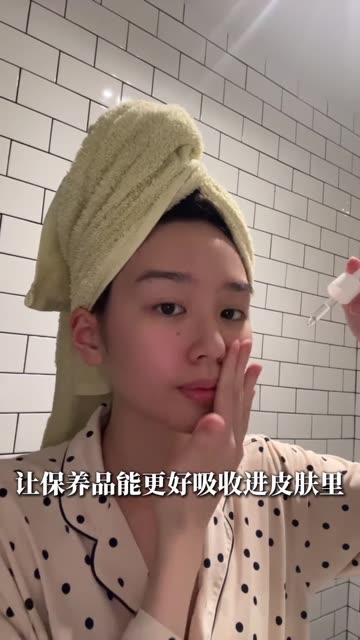
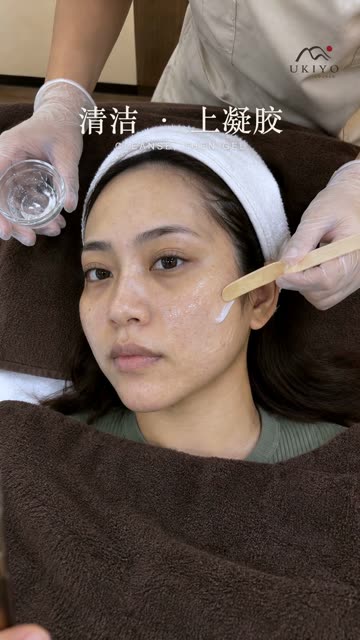
3 · Your three reels, every shot
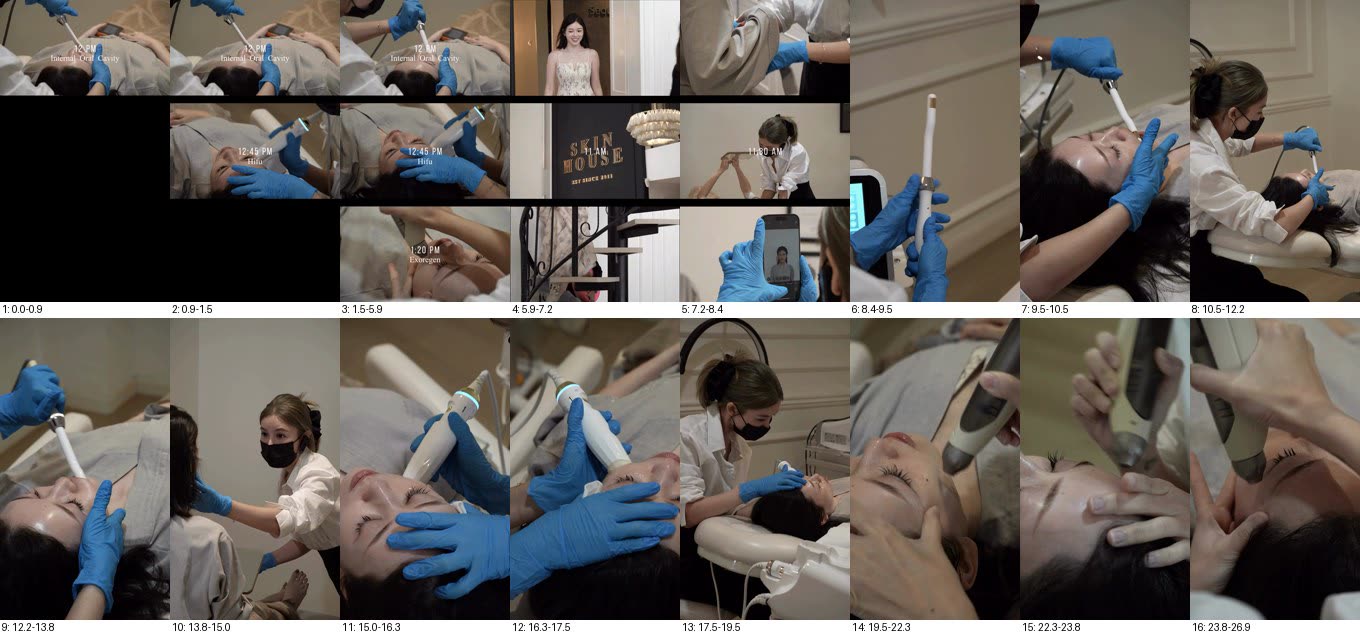
Skin House: real crew at work (16 shots)
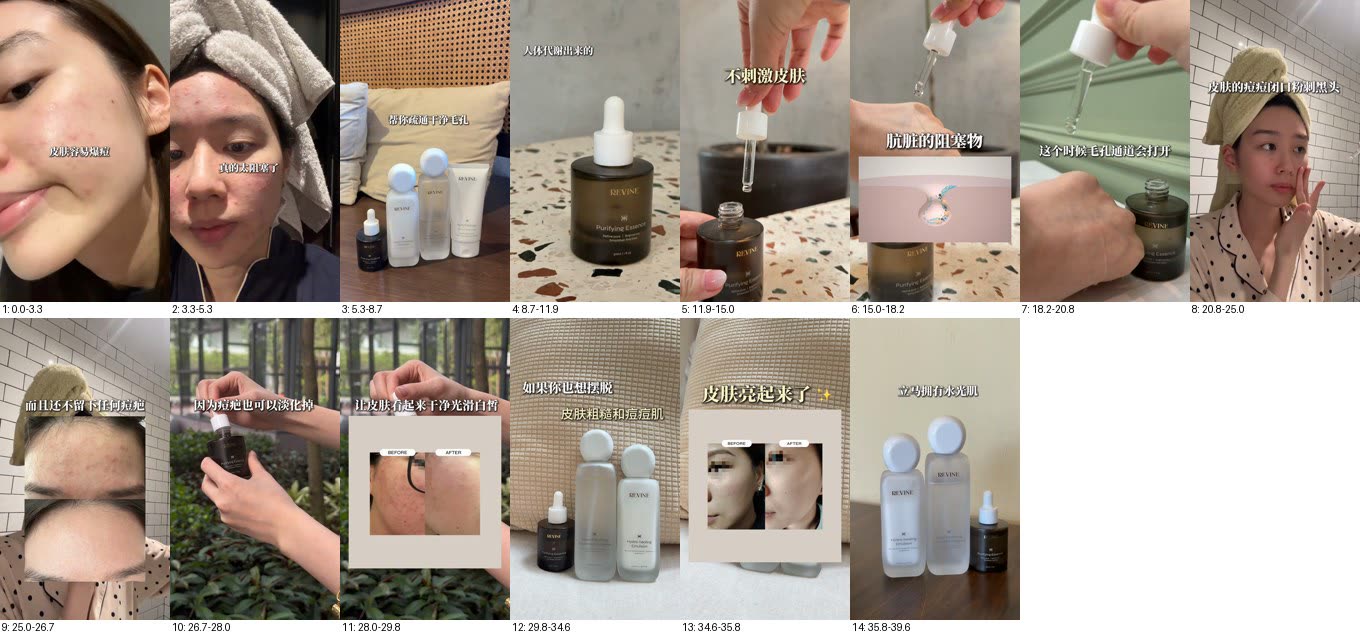
REVINE B: real UGC (14 shots)
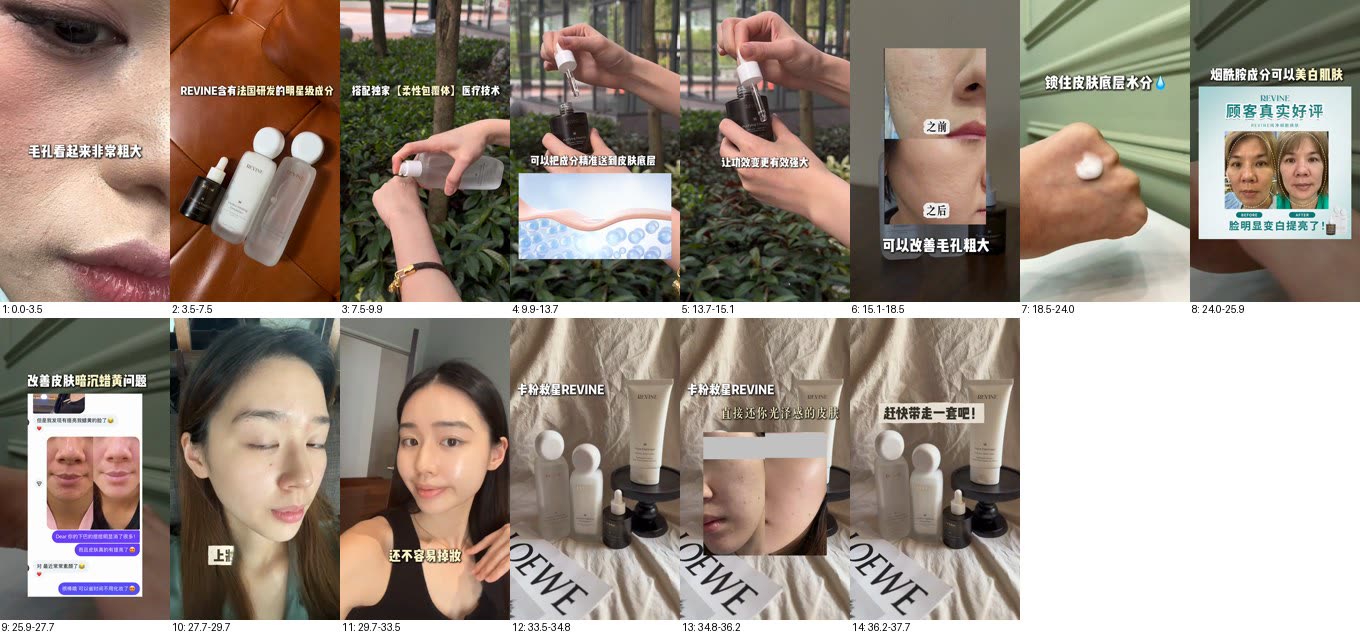
REVINE A: real UGC + skin macro (14 shots)
4 · The full study
Her note on v8: - "the treatment part still off … your study on the handheld machine is not accurate yet. How can you study the 360, complete device understanding of it for a video model?" - "Colour tone still too pale … a lot of angle still very staged. Not like real video shoot POV. 0.02 fake UGC scene · 0.03 fake skin tone scene … deep decode and decompose and study reverse engineer … real facial shots, real treatment shots, real facial crew at work, real UGC etc. use jev skill."
Sources studied:
- UKIYO's own 18 raw clips: ukiyo-celllight-w1/R3/real-usage/, all sampled; two rotation clips scanned at 2 fps.
- Her three new refs (src/):
- Skin House: DehBCifg_pD, 26.9 s, 16 shots, real crew at work;
- REVINE: Db5GkCFMUvk, 37.7 s, 14 shots, and Db5GeDtsVJ6, 39.6 s, 14 shots; real UGC + product.
- REF-2 (38-deep-decode/REF-2-DNA.md) and KONAP.
1. The device, in 360° (device/DEVICE-360-atlas.jpg)
What I had wrong
I modelled it as "a cream paddle with a red bar on its flat underside", taken from the re-rendered PRO sheet's single on-face panel. That is a simplification. The real handpiece, from IMG_8138 / IMG_8139 rotated in two hands:
| Part | Truth | Atlas view |
|---|---|---|
| Body | cream-white "egg" paddle, smooth back | B, C |
| Front | a recessed oval panel with a glowing violet logo strip when the machine is on | D, E |
| The light | a small rectangular adapter block (glass window, metal rim) slotted into one side of the head near the top. The block glows (red-orange in IMG_8139; blue / violet in IMG_5648-5649) | A (lit), B (off) |
| Interchangeable | the block pulls out of the head; the console's rack of gold/silver adapters are the alternatives, each a different light. This is the line 「再换上适合她皮肤的光」 | E, F |
| Grip | grey rubber boot at the bottom where the grey ribbed cable exits | B, C |
| Console | white, 6 blue display windows, adapter rack, light-bar column, docked handpiece | F, G, H |
How it is used on a face (from IMG_5643–8146; real client, so kept local and never shown on the board)
- Step order. Eye shields placed (5643) → clear gel spread with a wooden spatula (5644, 8142, 8143) → light set on the touch screen (5645) → light applied (5646, 5647, 8144, 8146; blue mode 5648, 5649).
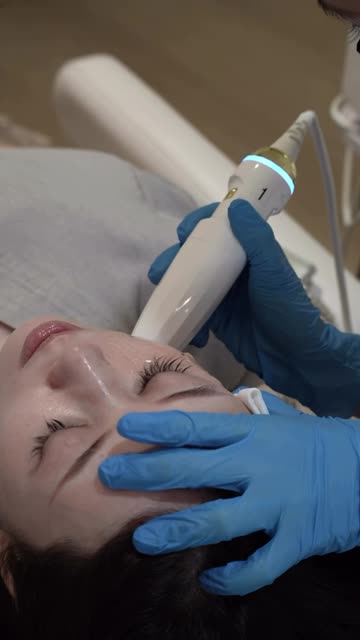
- What touches the skin is the SIDE BLOCK. So the body is often upright or diagonal against the cheek (8144, 8146), or lying along the jaw with the block under it (5647). The light spreads as a wide red-orange glow on the wet skin around the block.
- Hands. One gloved hand on the body, one on the grip / cable. The therapist stands at the side of the bed and leans in, rarely behind the head.
- Rhythm. Pressed and held, a slow small reposition, held again. A "beep beep" (3.4 kHz pair, 0.33 s apart) marks light pulses (8144 audio).
- Client. Ivory teardrop shields, white towel headband, a towel / blanket to the chest, her own clothes under it.
- UKIYO's real "skin check" (8140, 8141). The therapist photographs the client's face with a phone held over the bed.
Why the video model got it wrong, and how to give it the 360° understanding
- Asked from text plus one image, the model invents the hidden sides and the motion. When the device turns, it "draws" a new device: lettering, flips, a third hand, a jump across the face (all seen in v7/v8).
- Give it the truth, not a description:
- The motion and the device come from a REAL clip: Wan 3.0 reference-to-video (
intel/ukiyo-reel-reskin-2026-09-23/fire_wan_r2v.py: video = motion, image = look-lock). The real handpiece, grip, rhythm and light are carried over. Only the client's face, outfit and the room change (her rule). - Identity references from this atlas (views A, C, D), attached so any turn stays the same object.
- Only angles the atlas can support. New angles (macro, low phone angle) start from a keyframe, then get a device side-by-side against the atlas, frame by frame.
- Check every clip against the atlas: block on the side, oval panel, grey grip, two hands, no lettering on the body.
2. Realism DNA: what makes the refs read REAL (and v8 not)
Measured colour (14 frames per reel, same method)
| Reel | Brightness | Contrast (p95−p5) | Skin L* (lightness) | Skin b* (yellow) |
|---|---|---|---|---|
| Skin House (crew) | 92 | 159 | 49 | 12.6 |
| REVINE A (UGC) | 121 | 177 | 60 | 18.3 |
| REVINE B (UGC) | 138 | 162 | 57 | 17.9 |
| REF-2 | 114 | 184 | 61 | 25.3 |
| UKIYO raw IMG_8144 | 161 | 148 | 53 | 18.1 |
| Ours CL-M01 v8 | 134 | 138 (flattest) | 60 | 20.9 → corrected to ~14.7 on face shots |
| Ours NG-M10 v8 | 111 | 167 | 60 | 22.5 → corrected to ~14.5 on face shots |
What "pale" and "fake skin tone" actually are: 1. Even, shadowless light and low contrast (CL-M01: 138 vs 148–184). The refs have a real light direction: window side light, overhead practicals, real shadow under the jaw. 2. My "skin-yellow guard" pushed face skin to b* ≈ 14.5. Real treatment / UGC skin sits around 18 (12.6–25.3). On the face shots that made skin cool and grey-pink: the 0:02 / 0:03 shots (NG-M10 result selfie / gel step) had the strongest correction (blue +9–13 %, red −4–6 %). The guard is wrong for this footage. Removed. 3. Generated skin is uniformly smooth and fair with no specular texture. Real skin has oily highlights on the nose and forehead, pores, uneven tone and redness.
Shot types in the refs → their DNA → reverse-engineered prompt
| Real shot type | Where | Camera / who holds it | Light | Skin / people | Motion / imperfection | Reverse-engineered prompt core |
|---|---|---|---|---|---|---|
| UGC bathroom selfie | REVINE B s2, s8 | her front cam at arm's length, slightly above, wide lens close | window daylight from one side, white tiles bounce, slight overexposure | towel turban on wet hair, polka-dot pyjamas, real acne and uneven tone, no makeup | phone sway, she touches her cheek mid-sentence, eyes on the screen not the lens | "front-camera phone selfie video in her own small home bathroom, white wall tiles, a hair towel wrapped on her head, pyjamas, window daylight from the left with a hard highlight on her forehead, unretouched skin with real acne and pores, she looks at herself on the screen and touches her cheek, natural phone sway, slight overexposure, no makeup" |
| UGC skin macro | REVINE A s1, B s1 | phone a hand-span from the cheek, slightly soft focus edge | daylight, harsh enough to show pore relief | pores, fine hairs, oil sheen, acne | a little hunting focus | "phone macro of her cheek 10 cm away in window daylight, enlarged pores and oily sheen, fine vellus hairs, slight focus breathing" |
| Crew at work, wide | Skin House s8, s10, s13 | a second person's phone/camera at standing height beside the bed, 1–2 m | warm ambient room light, no fill, darker corners | therapist in black mask + white shirt + blue gloves leaning over the client; client lying, real face | handheld drift, people move naturally, framing not centred | "handheld video from beside the treatment bed at standing height: the aesthetician leans over the client and works the device along her jaw, warm room light with dark corners, framing slightly off-centre, natural handheld drift" |
| Treatment close-up | Skin House s11, s12, s14–16 | camera at the client's head height, 30–50 cm, over her shoulder / from the side | warm practical light, gel highlights | device tip on gel-wet skin, two gloved hands, skin texture visible | device moves in short strokes, hands adjust | "close-up from the side of the bed at the client's head height: two gloved hands hold the device on her cheek over shining gel, warm room light, real skin texture, short deliberate strokes, slight handheld movement" |
| Device to camera | Skin House s6 | therapist holds the device up to the lens | room light | gloved hand, device in focus, background soft | small turn of the device | "the aesthetician holds the handpiece up to the camera in her gloved hand and turns it slightly, room soft behind" |
| Self-filmed treatment POV | REF-2 s1, s4–s7 | the client's own phone on the bed | flat clinic overhead | dark towel block, wet skin | (see REF-2-DNA.md) | (see REF-2-DNA.md) |
| Day-in-clinic timeline | Skin House s1–5 | collage panels with time stamps (12 PM / 12:45 PM / 1:20 PM) | — | — | — | (edit device, not a gen) |
| Before/after card | REVINE A s6, B s11, s13 | two stacked or side-by-side real photos on a beige card, 之前 / 之后 labels | — | real faces | — | (edit device; ours = the PIP) |
What our v8 frames did instead (why "staged")
- The camera is always at an ideal, centred position, at the exact height for a pretty composition. Real phones are off-centre, too close or too low, and moving.
- Light is soft and frontal everywhere. No window direction, no dark corners, no hard highlight.
- Every person is posed and still. In real footage hands adjust, people talk, glance away or blink.
- Rooms are tidy, generic "spa". Real rooms have the real bathroom tiles, the towel hook, the phone on the bed.
3. Jev map (jev-study-20261015, jev-route2-20261015; jev-1.13.0)
Causes of her v8 notes. Controls correct: planted-obvious → A 0.96; planted-none → none 0.57.
| Note | Main cause |
|---|---|
| treatment off | device modelled from one simplified sheet, video model invents hidden sides and motion (1.00) |
| staged angles | ideal centred camera + posed people, no real phone POV (1.00) |
| 0:03 fake skin tone | my skin-yellow correction (0.61), then over-fair generated skin (0.36) |
| 0:02 fake UGC | correction 0.41 / fair skin 0.28 / staged camera 0.22 |
| pale | my correction 0.48 / fair, smooth skin 0.46 |
Route per shot type. The first ask was REJECTED: both planted controls failed and it chose motion transfer for everything. It was re-asked with each route's prerequisite stated; controls then correct (console → real footage 0.96; selfie with no clip → keyframe 0.99).
| Shot type | Route | Jev |
|---|---|---|
| light block on the cheek (UKIYO has 4 real clips) | Wan reference-to-video from the real clip (real motion and device; new face, outfit, room) | 1.00 |
| extreme close-up from her chin (no real clip) | generated keyframe → Wan i2v, device checked against the atlas | 0.91 |
| UGC selfie (no real clip) | generated keyframe → Wan i2v with the UGC DNA above | 0.99 |
| adapter swap (UKIYO clip IMG_8138: hands and device only) | UKIYO's real footage as-is, graded | 0.76 |
4. v9 method (proposal; needs her OK, since the test spend cap is reached: 120.75 of 125 credits)
- Device truth:
- Every treatment shot on a face = Wan reference-to-video driven by a UKIYO real clip (5647 jaw / 8144 cheek / 8146 diagonal / 5649 forehead, blue).
- The look-lock keyframe = that clip's first frame edited: new customer (face-lock), new outfit, UKIYO room.
- Atlas views A, C and D attached as device identity.
- Real adapter swap and console = UKIYO's real footage. This shot carries 「再换上适合她皮肤的光」.
- Treatment angles a real crew films (Skin House DNA):
- wide from beside the bed at standing height;
- close from the side at her head height;
- the device held up to the lens;
- the client's own phone POV (REF-2).
- UGC shots (REVINE DNA): her real bathroom (tiles, towel turban, pyjamas), window daylight from one side with hard highlights, unretouched skin, phone sway, eyes on the screen.
- Colour:
- no grain (done);
- no skin-yellow correction (removed);
- prompts ask for real light direction, darker corners and real skin texture;
- check skin L* 50–57 and contrast ≥ 150 against these refs.
- Proof first: ONE treatment shot (8144 → Mei) and ONE UGC selfie, about 15–20 credits, before any full reel.
5. Proof results (15 Oct night, her "Ok. lets test"), on the board as RV-PF-T / RV-PF-U
Spend: 14 credits. The r2v price isn't on file, so it was estimated at 1.75/s.
Pre-fire Jev check (40-proof/jev/pre-20261015). Controls separated: v7 studio prompt 0.92, REVINE-derived prompt 2.21.
| Prompt | DNA score (of 3) |
|---|---|
| treatment edit | 2.82 |
| treatment motion | 2.37 |
| UGC keyframe | 2.77 |
| UGC motion | 2.06 |
Measured, against the real clip and the rejected v8 clip:
| Clip | Skin L* | Skin b* | Contrast |
|---|---|---|---|
| Treatment proof (r2v from IMG_8144) | 49.7 | 16.8 | 169 |
| Real UKIYO clip | 50.5 | 17.9 | 137 |
| v8 treatment (rejected) | 60.2 | 19.5 | 168 |
| UGC proof | 54.4 | 17.6 | 146 |
| Real REVINE UGC | 58.4 | 18.3 | 165 |
| v8 selfie (rejected) | 63.0 | 21.0 | 196 |
Post-fire Jev audit (40-proof/jev/post-20261015). Controls: real footage 2.98 / 2.97; rejected v8 0.04 / 0.01.
| Proof | Realism (of 3) | Main gap left |
|---|---|---|
| Treatment | 2.00 | keeping Mei's identity, 0.71 |
| UGC | 2.15 | skin rendering, 0.51 |
What carries over: - The device problem is solved by motion transfer from UKIYO's real clips. - The remaining work is identity lock (the same face across shots) and skin rendering on the generated shots.